What is Tella and who is it for?
Tella records your screen, camera, microphone and system audio, then gives you a full editor before you share a link or export in up to 4K. It suits people who make videos other people will judge: product demos, tutorials, onboarding videos, sales videos and YouTube content.
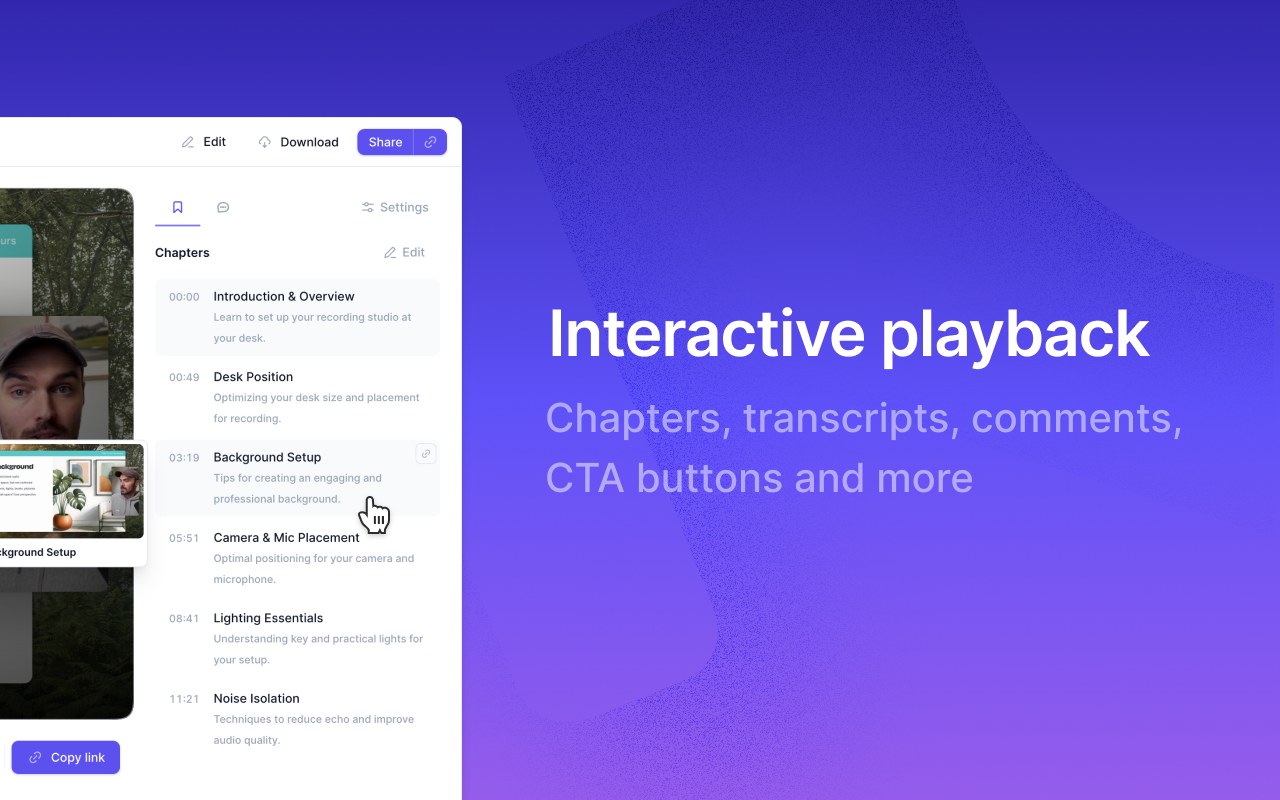
Screen and camera are recorded as separate tracks, so you can switch between side-by-side, picture-in-picture and full-screen layouts after recording. Auto Layouts, Auto Zoom and Auto Cut handle the busywork, and you can delete mistakes, filler words and silences by editing the transcript instead of a timeline. Transcription covers 106 languages. Videos are hosted with chapters, comments, reactions, call-to-action buttons and viewer analytics. Tella runs on a native Mac app, a Windows app (labelled beta in Tella's own Loom migration guide), a Chrome extension and a web recorder. There is no phone app; a mobile browser can record quick camera videos but can't edit.
How much does Tella cost in the UK?
Tella charges in US dollars per paid seat: Pro is $26 a month or $13 a month billed annually, and Premium is $39 a month or $19 a month billed annually.
- Pro: unlimited videos, 6-hour clips, 4K export, 60 FPS for videos up to 5 minutes, analytics history of 30 days
- Premium: everything in Pro plus a custom domain, removal of Tella branding, embed domain restriction, 60 FPS at any length and all-time analytics
- Enterprise: custom pricing with SSO, SCIM, a shared Slack channel and volume discounts
Viewers are free seats, so only the people who record and edit count towards the bill. SSO and SCIM can be added to any paid plan; Tella's help centre lists SSO at $125 a month. The pricing page doesn't mention VAT or pounds.
Tella vs Loom: which is better?
Tella is the stronger choice for polished, edited videos, while Loom is cheaper to start with because it has a free plan.
Loom's free Starter plan allows 25 videos of up to five minutes at 720p, and its pricing page lists Business at $18 and Business + AI at $24 per user a month. Tella has no free plan, but annual Pro at $13 a seat undercuts both, and its editor goes further: layouts, zooms, backgrounds, transcript editing and 4K export are all included. Tella also imports public Loom videos and folders, and its free Tella Transfer app for Mac and Windows exports a private Loom library. Loom remains the simpler pick for teams that mainly record quick async updates and already use Atlassian tools.
Tella vs Cap: which should you pick?
Cap is the cheaper option, and Tella is the more complete editor and video host.
Cap is open source, free for personal use, offers a $29 a year commercial desktop licence, and Cap Pro costs $12 per user a month or $8.16 billed annually. It also runs on Linux and can be self-hosted. Tella costs more but adds transcript-based editing, AI audio clean-up, conversion funnels and viewer-level analytics, call-to-action buttons on video pages and publishing straight to YouTube, LinkedIn, X and TikTok.
Is Tella worth paying for?
For people who publish demos, tutorials or course videos every week, reviewers suggest it is, mainly because editing takes minutes rather than hours.
Tella scores 4.8 out of 5 on the Chrome Web Store from 67 ratings and 4.8 on Product Hunt from 38 reviews, where users often mention producing more videos in less time and leaving Loom. The criticisms are bugs and a narrower feature set than full video editors, both raised by a Product Hunt reviewer. For occasional quick messages, a free tool will do.
How do you get Tella cheaper?
Annual billing is the biggest saving, cutting the monthly price roughly in half.
Teachers, professors and students at accredited institutions get six months of Pro free through Tella for Education, then 50% off for as long as they qualify. Registered charities, including UK charities, get 50% off Pro or Premium through Tella for Good. Enterprise customers get volume discounts.