
Free start
Free
5 free test runs for every new team, no card needed
- Full end-to-end runs on web and mobile
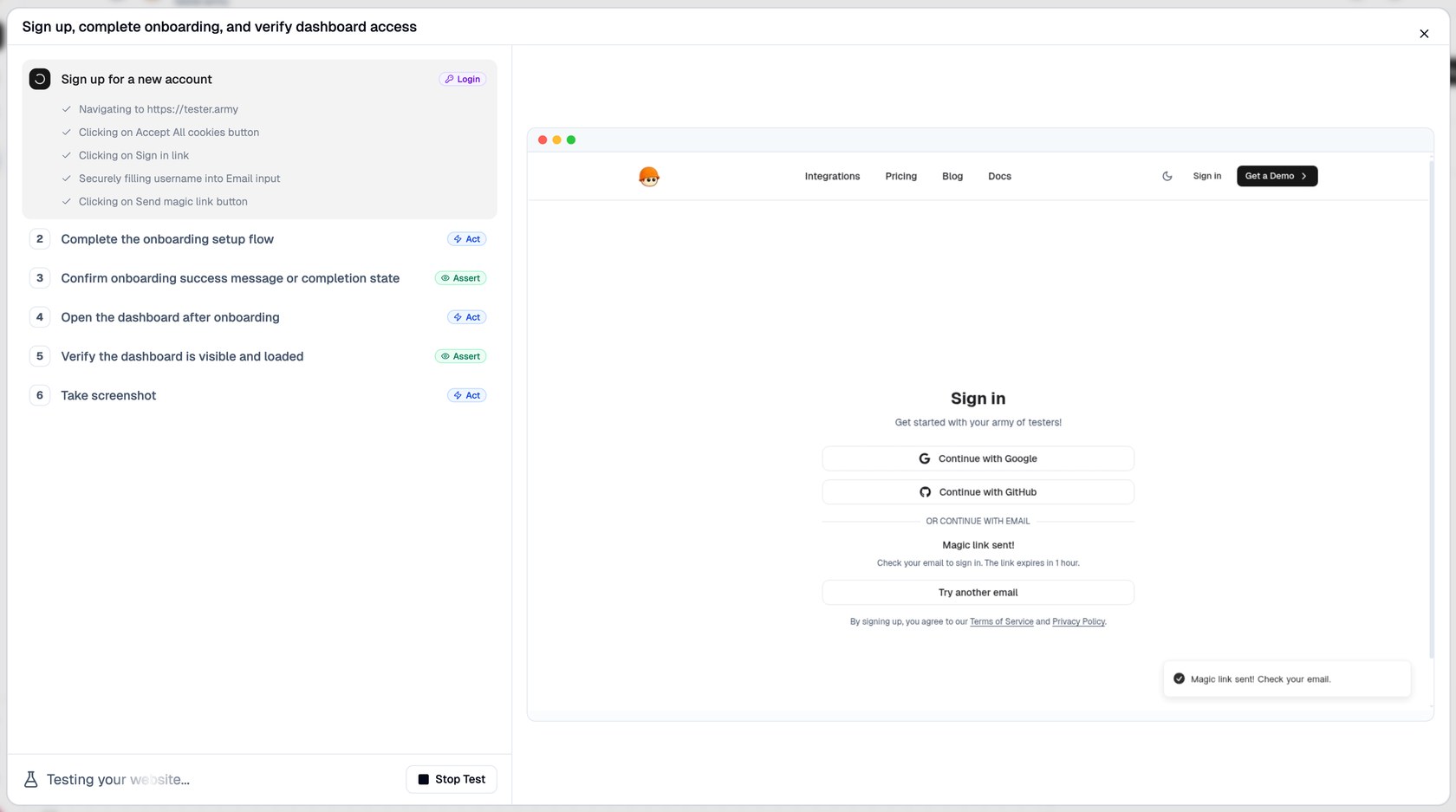
A web test run with its steps and recording

AI agents that test web, iOS and Android apps from plain-English steps and report pass or fail with video and screenshots
Prices in US dollars as TesterArmy's pricing page showed them on 11 October 2026.
TesterArmy runs end-to-end tests on web and mobile apps with AI agents: you describe a user journey in plain English and an agent clicks through it in a real browser, iOS simulator or Android emulator, then reports pass or fail with a video. It suits small product teams without dedicated QA. Every new team gets 5 free test runs; Hobby costs $99 a month, or $83 billed yearly.
You write the steps of a user journey in ordinary sentences, or describe a flow and let TesterArmy suggest the steps. The agent then navigates, clicks, types and checks the result in a real browser.
You upload an iOS simulator build or an Android .apk and the agent taps through it on cloud iPhone, iPad or Android devices. Native, React Native, Expo and Flutter apps are supported.
Connected to GitHub with Vercel, Netlify or Coolify, it tests each preview deployment and posts the results, recordings and failures as a comment on the pull request.
Each run returns a pass or fail verdict, a step-by-step transcript of the agent's reasoning, screenshots, a video and accessibility warnings from an axe-core audit.
Tests can sign in with stored credentials, basic auth or custom headers, and use built-in email inboxes and SMS numbers to get through OTP and magic-link steps.
Test groups can run on a schedule against your live site, with summaries sent to Slack, Discord, email or a webhook.
Runs can start from the ta command-line tool, a REST API or a hosted MCP server, so coding agents such as Claude Code, Cursor and Codex can write and run tests themselves.
Works with
Free
5 free test runs for every new team, no card needed
$99a month
Up to 250 test runs a month
$299a month
Up to 1,000 test runs a month
Contact sales
Custom runs, concurrency and projects
Prices in US dollars; VAT not mentioned. Yearly billing saves about 15% ($1,000 a year for Hobby, $3,000 for Startup). No refunds for part periods under the terms. Prices in US dollars, from TesterArmy's pricing page on 11 October 2026. TesterArmy may charge VAT on top, and prices can change.
TesterArmy's Hobby plan costs $99 a month and its Startup plan $299 a month, both in US dollars, with Enterprise priced on request. Prices are only shown in dollars, so a UK card is charged in dollars and your bank may add a foreign transaction fee. The pricing page doesn't mention VAT.
Hobby includes up to 250 test runs a month, 3 running at once and 2 projects. Startup includes up to 1,000 runs, 10 at once and 5 projects. Both have unlimited team members, web and mobile testing, and GitHub, Slack and webhook integrations. Enterprise adds custom limits, SSO and SAML, Slack Connect support with an SLA, onboarding help and the option to self-host.
Each run counts once, however it starts: from the dashboard chat, the command line, a GitHub deployment or a schedule. One run can last up to 20 minutes.
When a team hits its monthly limit, new runs are blocked until the quota resets on the 1st of the next month, unless you upgrade or ask for a higher limit. A team that tests every pull request across several flows can reach 250 runs quickly, so it is worth counting how many checks each deploy triggers before choosing a plan.
It is worth a look for teams that ship often and have no one writing Playwright or Cypress scripts, because tests are written as plain sentences and the agent works out the clicks. Each run returns screenshots, a video, a step-by-step transcript of the agent's reasoning and accessibility warnings from an axe-core audit.
TesterArmy is a very young company, part of Y Combinator's Spring 2026 batch, and no ratings were found on G2, Capterra, Trustpilot or Product Hunt. The 5 free runs are the safest way to judge it on your own app. Its documentation lists what it can't do: physical devices, Face ID and camera flows, load or penetration testing, and unit tests.
Yes, on cloud simulators and emulators rather than real phones. You upload an iOS simulator build as a zipped .app bundle or an Android .apk or .apks file, and the agent taps through it as a user would.
It supports native apps, React Native, Expo and Flutter, with iOS 26.4 on iPhone and iPad simulators and Android 15 on a phone emulator. Expo's own documentation includes a guide to running TesterArmy from EAS builds, and GitHub Actions and Bitrise can send builds automatically. Signed .ipa files and Android .aab archives aren't accepted.
They check different things, and many teams could use both. CodeRabbit reviews the code in a pull request and comments on bugs and style before anything runs. TesterArmy tests the running app: it opens the preview deployment from Vercel, Netlify or Coolify and checks that sign-up, checkout or onboarding still work, then posts the result on the pull request.
Compared with writing your own Playwright or Cypress tests, TesterArmy trades control and cost for speed of setup. Scripted tests are free to run on your own machines but need maintaining as the interface changes.
TesterArmy states that website passwords are stored encrypted with AES-256-GCM, screenshots are kept in Cloudflare R2 and project memories aren't used to train models for other customers. Its capability file lists processing in the United States and the European Union, and test browsers can run from US, German or Polish IP addresses.
The company is TesterArmy, Inc., registered under Delaware law with its team in Warsaw. It lists no third-party security attestation in its own capability file, so UK businesses with strict supplier checks should ask for security documents before connecting production accounts. Deleting an account is immediate and permanent.
 Free plan
AI code reviews on pull requests, in the editor and in the terminal, for GitHub, GitLab, Bitbucket and Azure DevOps
We don't currently list a confirmed discount code. That doesn't mean the store has no promotions; check its website for current prices.
Every new team gets 5 free test runs with no card needed, enough to try a full test from start to finish. Ongoing use needs the Hobby plan or above.
Yes. You cancel from the dashboard settings and the plan stays active until the end of the billing period. The terms say there are no refunds for part periods or unused time.
No. Tests are written as plain-English steps, and the agent can also suggest steps from a short description. Developers can trigger runs from the CLI, the REST API or an MCP server in Claude, Cursor or Codex.
Yes. It can use stored credentials, basic auth and custom headers, and it provides email inboxes and SMS numbers so tests can complete OTP and magic-link sign-ins.
About 15%. Hobby drops from $99 to $83 a month, billed as $1,000 a year, and Startup from $299 to $250 a month, billed as $3,000 a year.