

One finished little building is enough to discover whether card model-making is for you. You do not need a railway, a cutting machine or a plan for an entire miniature town. A small kit and the tools its instructions actually call for are enough; the reward is getting something from a flat sheet to a scene you can hold.
What is card model-making?
You take printed card parts and put them together into a 3D object. Buildings are a good place to start because you can see how the walls, windows and roof all fit together. Some kits come pre-cut and some need more cutting, so the kit's own description matters more than assuming they all work the same way.
 Metcalfe ModelsMetcalfe ModelsMetcalfe Models makes pre-cut card building kits for railway modellers, sold direct from Bell Busk near Skipton in 00/H0 and N scales. Its kits arrive as printed sheets with componBuying guide · View store → explains its pre-cut kit format. You press the printed parts out of the sheets and build them following the guide in the box. Its customer gallery also shows finished scenes. It's worth a browse to see whether you like the look of them, before coming back down to earth and picking something small for your first go. The gallery is people's best work, not their first attempt.
I like a small, contained building project for one simple reason: it ends. You can put it on a shelf, look at it and decide whether you enjoyed making it before you spend another penny.
Why do people take it up?
Card kits sit mostly in the model railway world, which is why Metcalfe sells its range in railway scales. In the UK, "card modelling" is searched about 170 times a month, against about 4,400 for "Metcalfe Models", the card kit maker in this guide, and 4,400 for "model railway" (Google Keyword Planner, October 2026). Away from the layouts, the appeal is that a kit is cheap, quiet and fits on a kitchen table.
Why should you care before you buy?
Because the kit is the cheap part. The station shelter below was £10.50 in September 2026, but tools, glue and delivery are extra, and the hobby makes it easy to buy a cutting machine and a box of scenery before you know whether you enjoy it. Scale matters too: parts made for 00/H0 and N don't match, so a present for someone with a railway needs their scale.
The short answer: MetcalfeMetcalfe ModelsMetcalfe Models makes pre-cut card building kits for railway modellers, sold direct from Bell Busk near Skipton in 00/H0 and N scales. Its kits arrive as printed sheets with componBuying guide · View store →'s PO316 Little Cardleywick station shelter is a good first build. It's a small building, and the product photos, a downloadable footprint and the full kit instructions are all online before you buy, which tells you a lot more about what you're signing up for than a box with a nice cover. The tools worth buying are the ones its instructions ask for, and nothing else until the first model is finished. The model and kit shops we cover are on our models and kits page.
The beginner kit
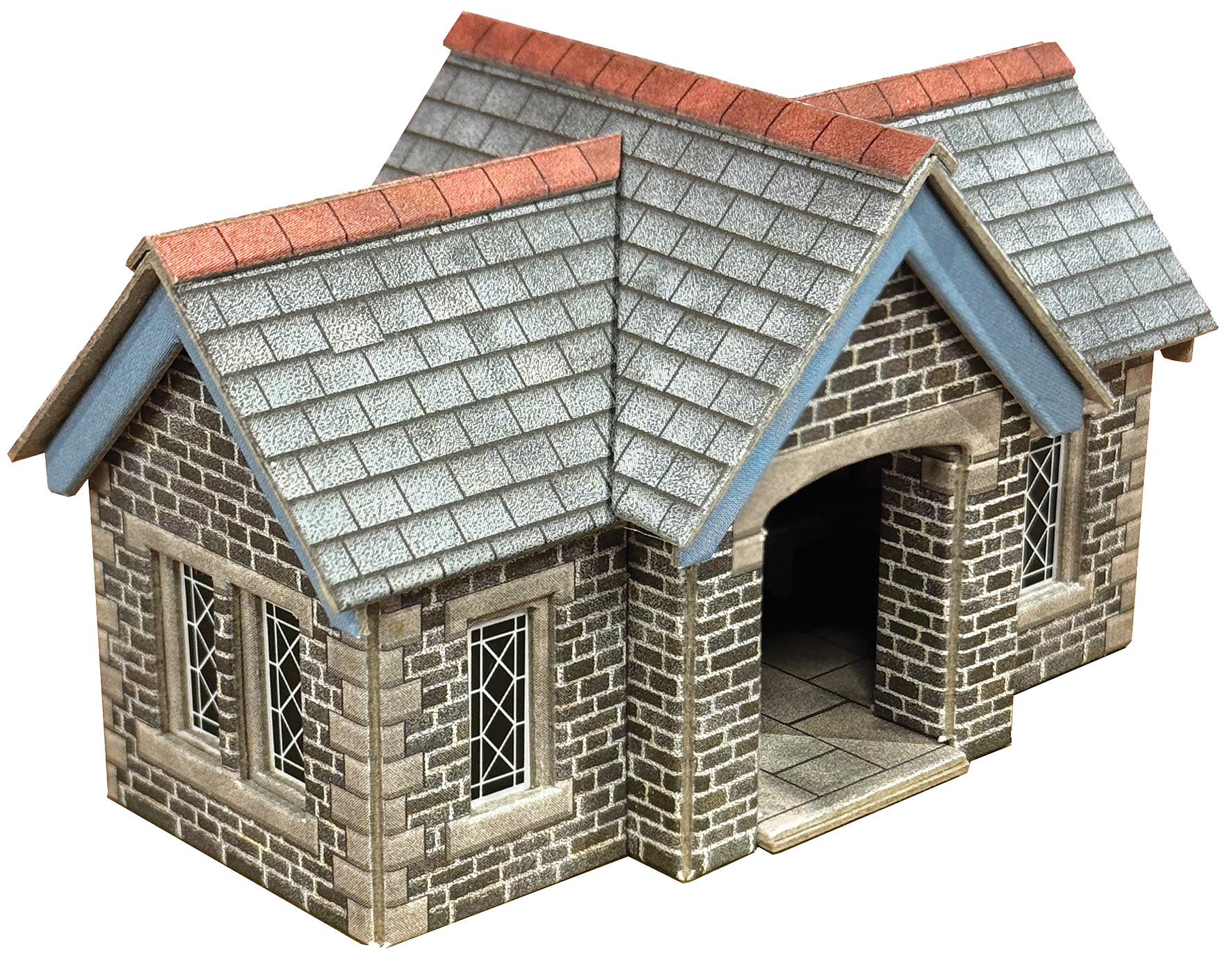 A first card build
Metcalfe PO316 Little Cardleywick Station Shelter
A small 00/H0 scale card building with illustrated instructions you can inspect before buying. Check the glue and tools list as well.
- Scale
- 00/H0
- Format
- Pre-cut printed card
- Instructions
- Downloadable before purchase
Metcalfe ModelsCheck price
What does the first kit cost?
The PO316 station shelter was listed at £10.50 and in stock on 21 September 2026. That's just the kit, not a full beginner's basket with delivery, so shipping and any tools or glue you need come on top.
The product page doubles as your picture reference. The roof, the openings and the finished proportions are all there, and the footprint shows how much space it actually takes up. Photos with nothing familiar next to them can make a tiny model look way bigger than it is, and you might be surprised by how small it is when it arrives.
The manufacturer's illustrated kit instructions are worth opening before you order. If working through them sounds like a nice evening, that's a much better reason to buy than a discount badge. If it looks like a special kind of torture, no harm done. One of our other nerdy hobbies might suit you better.
Which scale should I pick?
For a first project that isn't going on a layout, the right scale is one you can handle comfortably and that'll look nice on a shelf. MetcalfeMetcalfe ModelsMetcalfe Models makes pre-cut card building kits for railway modellers, sold direct from Bell Busk near Skipton in 00/H0 and N scales. Its kits arrive as printed sheets with componBuying guide · View store → splits its range into 00/H0 and N. Products from the two don't mix: the windows, doors and little people won't match, and it'll bug you forever.
If it's a present for someone who already has a railway, it's worth asking what scale they use and which product they'd actually want. "They like trains" isn't enough to pick a building that fits. Our Christmas hobby-gift guide has more ways to avoid that sort of well-meaning mistake.
Setting up without taking over the kitchen
You need a steady surface with good light, and something to protect it if there's any cutting. The kit's tool list comes before buying anything. Small parts stay sorted in a shallow tray or in labelled piles, and bits need somewhere flat to sit while the glue dries, ideally somewhere the cat can't get to.
A first session can be small: reading the instructions, finding all the sheets and working out the first bit of assembly. You don't have to finish the whole thing that night. Rushing because someone needs the table for tea in ten minutes is miserable. Better to pick a spot where you can leave it out.
If you do need a knife, a proper cutting surface and fingers well out of the way are the rules, and the instructions cover the tools and the glue. And "pre-cut" doesn't mean "no tools at all". There can still be small tabs to trim or bits to adjust.
How not to buy half a hobby shop
I'd make two lists. One is what this kit needs. The other is everything that looks lovely in somebody else's workshop on Instagram. Only the first list gets bought, and the finished model tells you whether the second one matters.
A cutting machine, a big box of scenery materials or a dozen matching buildings might be useful one day. You don't have to buy any of them before you're allowed to start. Your first model is there to answer one question: do you actually enjoy making these?
When a sale comes along, our Black Friday comparison method helps: it compares the useful bits, not how many items are in the bundle. A massive kit at a great price is still a massive unfinished kit if all you wanted was a quiet Sunday project.
What next, once the first building's done?
The next step is just one thing: a small base, a building to go next to it, or a more ambitious kit, following whatever you enjoyed most. You might find you love building little bits of architecture and couldn't care less about running trains, and that's a perfectly good direction to go in.
You can also photograph the finished thing, give it away, or just leave it on the shelf. It doesn't need to become a collection, a side business or an Instagram account to be worth the time.
And if building turns out to be the part you love more than card, our guide to LEGO sets for adults goes the other way, from a small shelf build to a whole museum.


